Waves hold enough energy to meet about 60% of U.S. electricity demand. We cannot harness the power of every wave. But if we can capture even some, that energy could help power coastal communities and ocean industries and build a more reliable power grid.
So why are we not already harnessing all that power?
Marine energy developers are still refining early-stage technology designs. To edge them closer to commercial success, they need data to help answer critical questions such as how a prototype performs in the ocean, how much energy it captures, and how it responds to changing conditions. With this information, teams can identify weaknesses early, improve efficiency, and design more robust systems. By enabling this kind of testing and de-risking, developers can reduce the likelihood of costly failures, avoid over- or under-engineering, and make more informed design decisions before scaling up.
That is why National Laboratory of the Rockies (NLR) researchers developed the Modular Open-Source Data Acquisition (MODAQ) system a data acquisition platform that provides developers and researchers the field feedback they need to validate marine energy technologies.
Now, a new version of MODAQ MODAQ 2 makes it even faster and easier to deploy, test, monitor, and control novel marine energy technologies.
"We wanted MODAQ to be more open," said Casey Nichols, a mechanical engineer in NLR's water power team who helped build the latest version. "The new version gives developers more options to fit their needs."
The MODAQ systems are and always have been highly customizable. Now, developers can choose a system that fits a smaller budget, relies on more popular (and therefore more available) programming languages, or scales down to a size that better suits their technology. Even if a developer chooses a smaller budget or size, they do not need to compromise on performance.
"With MODAQ 2, they can slide the scales and find a solution that meets their requirements," Nichols said.
The new system can do all that thanks to a little help from robotics.
Robotics-Inspired Smart Systems
Operating in the open ocean places unique demands on marine energy devices and the systems that support them. Instruments and data acquisition systems must operate reliably in remote environments, where access is limited and direct intervention is not always possible. As a result, marine energy devices function more like ocean robots than traditional energy infrastructure collecting large volumes of data and making real-time decisions amid shifting tides, powerful currents, storm-driven waves, and fluctuating water temperatures.
In many ways, these devices have more in common with lunar rovers than you might expect. Once deployed, they are sent into remote, unforgiving environments where humans cannot easily check on them. If something needs attention, researchers must rely on remote communication much like rover teams do because visiting the site is not always practical or possible.
To operate safely and collect data in these conditions, researchers rely on tools like ROS2 (Robot Operating System 2), a widely adopted open-source robotics framework. ROS2 enables real-time control and data collection, giving researchers the ability to power devices on and off, adjust settings, and gather performance and environmental data all without leaving the shore. In effect, these tools give teams "eyes" on their devices, making it possible to monitor and respond in real time, even when the technology is far beyond reach.
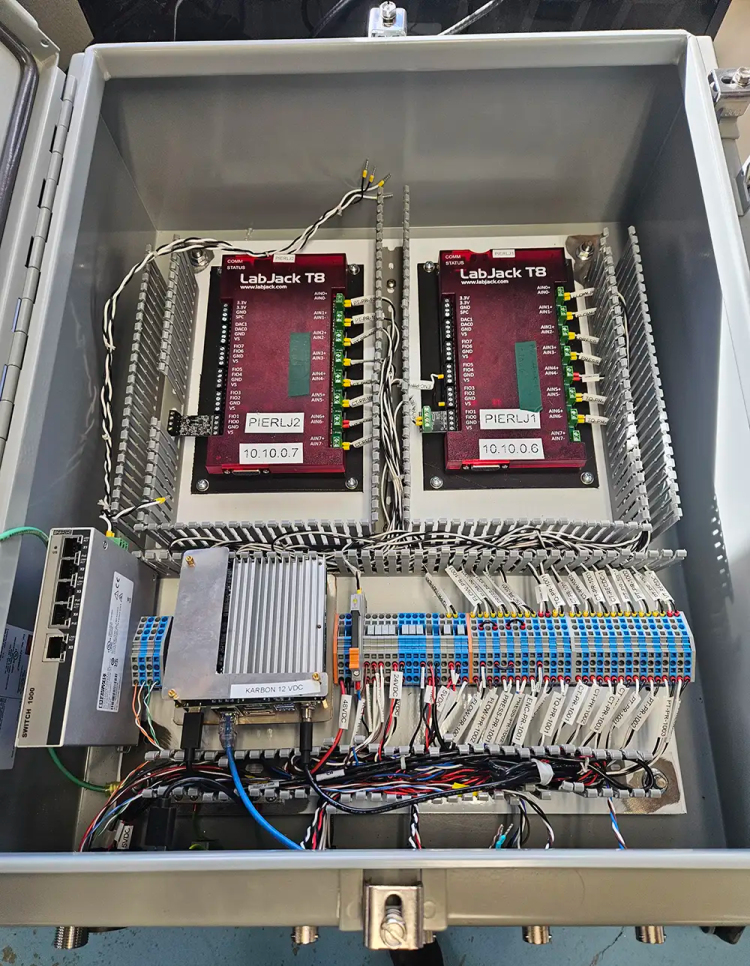
MODAQ 2 is being developed for the SurfWEC data acquisition and control system, which includes two LabJack measurement devices, a MODAQ 2 controller, and all supporting hardware required to deploy the MODAQ system in the field. Photo by Bri Friedman, National Laboratory of the Rockies
NASA scientists have also used ROS2 to run robots a human-like research bot and a task-oriented robot on the International Space Station and to control and gather data from one of their lunar rovers.
MODAQ 2 uses custom ROS2 packages developed by NLR that primarily interface with device hardware for data collection and, in some cases, real-time control. These packages enable multiple processes to run simultaneously, such as controlling device motors, managing flood control systems, and monitoring environmental sensors, while automatically handling tasks like saving data and logging events or errors.
Because ROS2 is open-source and widely used in robotics, developers can work with MODAQ 2 without special software or expensive licenses. The breadth of publicly available ROS2 documentation and community support also means many artificial intelligence tools have been trained on this information, making them well suited to assist ROS2 developers. Together, MODAQ's packages provide a simple, affordable way for researchers to test, refine, and scale their systems.
Where Code Meets the Coastline
MODAQ has already been deployed in several real-world tests. NLR has supported the University of Hawaii with its wave energy prototype and C-Power on its SeaRAY device, helping both organizations collect performance and environmental data while managing remote operations.
NLR engineers have been leveraging MODAQ 2 to test a small underwater research flap wave energy converter (called SURF-WEC for short), developed in collaboration with the University of Hawaii at Manoa. The SURF-WEC will be submerged in the ocean where waves will cause its flap to swing back and forth to generate electricity. The team plans to deploy SURF-WEC in spring 2026 off the Makai Pier in Oahu, where it is expected to remain in the water for up to a year.
MODAQ 2 will be at the heart of this effort. The system enables researchers to manage real-time controls such as actuating hydraulic valves, monitoring device power, and responding to changing wave conditions while capturing critical data on energy output, device motion, and environmental conditions. These capabilities allow the team to save costs and streamline testing by automating tasks like logging errors, saving sensor data, and uploading data to the cloud simultaneously capabilities that were not as accessible with earlier versions or proprietary systems. The SURF-WEC deployment highlights the flexibility and extensibility of MODAQ 2, supporting features such as distributed system design, human-machine interfaces, automated and manual control, remote management, and web-based dashboards.
Troy Heitmann, assistant researcher at the University of Hawaii at Manoa's Hawaii Marine Energy Center, has spent years working with traditional LabVIEW and MATLAB-based systems. While they are powerful tools, they come with significant licensing costs that can limit growth outside the university environment. MODAQ 2 is built on widely used, open-source programming languages with large user bases and active support communities, making it easier for teams to customize, maintain, and scale their systems. This shift allows project resources to be focused on advancing the technology itself rather than managing software constraints.
"MODAQ 2 is truly a game changer," Heitmann said. "We're excited to contribute to a growing community of developers that shares solutions and lessons learned for the ocean energy sector and broader scientific fields."
Leverage NLR's modular data acquisition systems to de-risk technology and accelerate its path to commercialization. Visit NLR's open-water testing webpage to learn more about the laboratory's research and capabilities and how developers can team with NLR on MODAQ. Code repositories, documentation, and development community are available on GitHub. The MODAQ 2 project is open-source, and therefore community involvement and contribution are welcome and encouraged.
For more information

1617 Cole Blvd
Golden Colorado
United States 80401-3305
www.nrel.gov