


Solar photovoltaics (PV) is one of the most widely deployed renewable energy technologies. It contributes to half of the world's total installed renewable capacity and is expected to play a major role in the energy transition. Accelerated deployment of solar PV is necessary to keep global climate targets achievable.
At the same time, this level of progress indicates a large number of decommissioned solar panels in the near future. Solar PV projects are designed to serve 25 to 30 years, after which the panels will be decommissioned as they reach the end of their service time.
In the International Renewable Energy Agency (IRENA)'s 1.5°C scenario, end-of-life solar PV panels at the global level are projected to exceed 25 million tonnes by 2050, or more than 400 gigawatts (GW) of solar PV capacity. Consequently, the collection and treatment of future end-of-life solar PV panels within the next decade will require at least 120 000 trips of heavy-duty trucks to transport them and over 150 fully operational medium-sized treatment facilities.
This is why it is crucial to adopt the circular economy (reduce, reuse, recycle) for end-of-life management of solar PV panels. Adopting a circular economy can prevent, minimise, and reutilise waste streams from decommissioned solar panels as much as possible.
In addition, a significant share of recovered materials from end-of-life solar panels can bring economic benefits. Technically, the recycling rate for valuable minerals can reach nearly 100% with future technological advancement. Today, recycling end-of-life solar PV panels can recover over 90% of materials, including copper, aluminium, silver, silicon and glass.
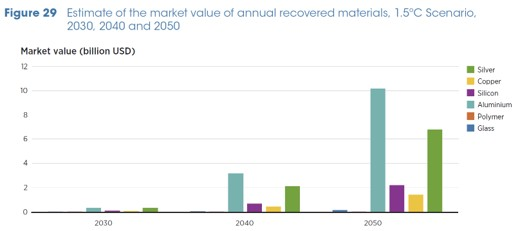
Once recovered, they can be traded in existing material markets and used to manufacture new industrial products, generating economic returns. Based on IRENA's estimation, the market value of annual recovered materials from end-of-life solar PV panels could reach USD 6 billion by 2040 and exceed USD 20 billion by 2050.
Apart from creating market value, adopting a circular economy for end-of-life solar panels can also create employment opportunities. The solar PV industry has already accounted for 43% of total renewable energy jobs in 2024, or over 7.2 million jobs worldwide.
By reusing and recycling end-of-life solar panels, new employment opportunities are created. A study by a social enterprises network in Europe shows that proper workforce training is estimated to generate 60 to 140 jobs per 1 000 tonnes of materials collected for e-waste reuse. In developing economies, waste collection, repair, reuse and recycling practices as part of the circular economy can generate income for those in the informal sector.
It must be noted, however, that policy framework must take into account the health impact of the practices, and safeguard the various social benefits that can improve the informal workers' quality of life. A just and inclusive framework for the circular economy in solar PV should include labour policies, safety standards, and environmental protection measures to ensure workers' health and safety.
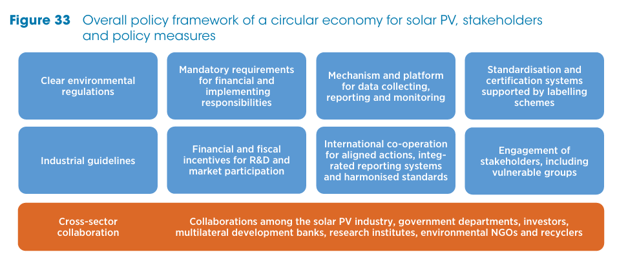
But policy designs vary among markets, depending on each context's economic structures and priorities. To ensure environmental goal is achieved and socio-economic benefits are gained, circular economy strategies for end-of-life panels also require engagement of various stakeholders across sectors.
For more information

336 East 45th Street, 11th Floor
New York New York
United States 10017
www.irena.org