
Simon Fraser University is celebrating remarkable success in the latest round of funding from the Canadian Foundation for Innovation (CFI).
The university received two major CFI Innovation Fund awards one for more than $7 million to scale up clean energy projects at the SFU Clean Hydrogen Hub, and the other for $5.3 million to advance particle research with the ATLAS Tier-1 Data Centre.
SFU also partnered on four further successful proposals, a major win in the prestigious, national competition, announced today (March 13).
"SFU is delighted to receive CFI funding to strengthen our leadership in clean hydrogen innovation, and to lead fundamental research in particle physics," says vice-president, research and innovation Dugan O'Neil. "We are privileged to collaborate with exceptional research partners across Canada and around the world in areas of strategic importance for our country, while also addressing important challenges of our times."
SFU will lead two major projects:
- SHIFT - Sustainable Hydrogen Infrastructure for Transitioning towards Community Scale
- ATLAS Tier-1 Centre and Distributed Computing at the LHC Energy Frontier
Powering clean energy for Canadian industry
SHIFT focuses on improving anion-exchange membrane water electrolysis more cost-effective than traditional hydrogen production methods using renewable energy. Hydrogen produced this way can help decarbonize transportation, power generation, heavy manufacturing, and other emissions intensive sectors.
Led by Steven Holdcroft, scientific director of the SFU Clean Hydrogen Hub, and Jason Keonhag Lee at the University of Victoria, in collaboration with the Université du Québec à Trois Rivières, SHIFT aims to make green hydrogen production more affordable and ready for community scale deployment.
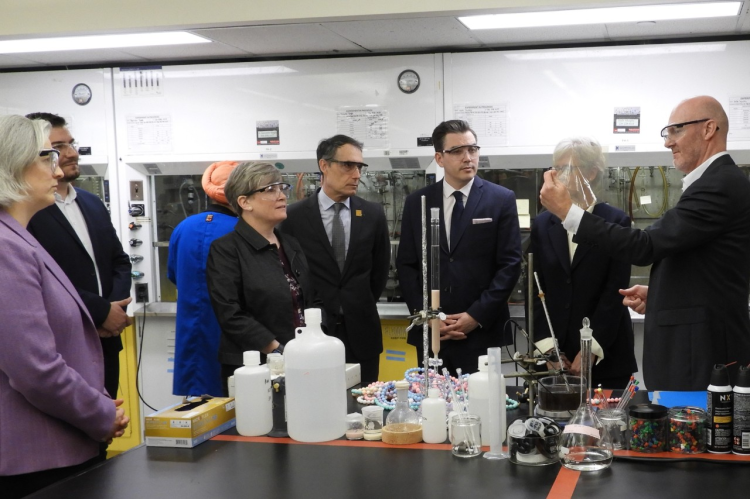
Holdcroft [far right] with SFU Clean Hydrogen Hub founders
The project builds on initial investments from PacifiCan, NorthX Climate Tech, FortisBC, the BC Ministry of Energy and Climate Solutions, and the City of Burnaby, announced in 2024. It also advances Canada's Hydrogen Strategy by helping reduce emissions, strengthening Canada's position in the global hydrogen economy, and training a workforce for the emerging hydrogen sector.
"We are excited to enter the next phase of work to make green hydrogen energy more affordable, scalable and sustainable," says scientific director Steven Holdcroft. "Producing green hydrogen through electrolysis using renewable energy presents a critical opportunity to reduce carbon emissions."
SFU Climate Innovation is a strategic research priority for SFU, and the funding will further support SFU's commitments to engage in critical research to support community-centred climate innovation and enhance Canada's international leadership in hydrogen energy innovation.
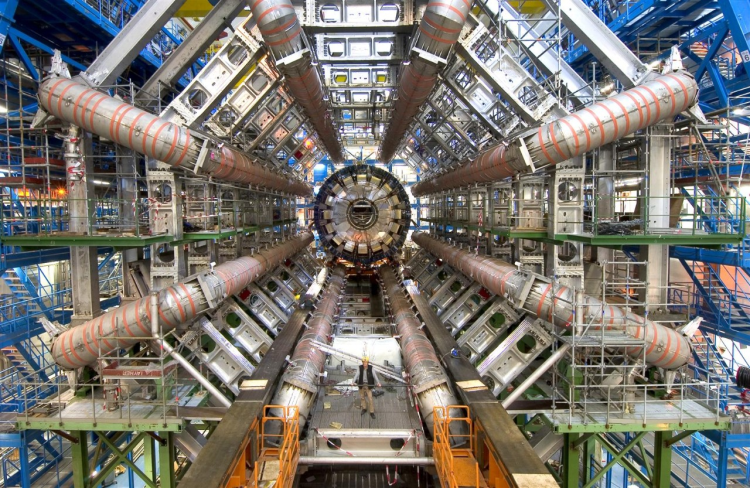
The ATLAS detector at CERN (pictured under construction) is one of the world's largest scientific endeavours. Image credit: CERN
Global research at the forefront of particle physics
The ATLAS experiment at CERN is one of the world's largest scientific endeavours, and studies proton-proton collisions from the Large Hadron Collider (LHC). These collisions recreate conditions that prevailed just moments after the Big Bang, offering insights into the fundamental laws of the universe.
ATLAS records vast amounts of data from the LHC, which are stored and analyzed through a global network of high-performance computing centres. SFU is home to Canada's Tier-1 Data Centre, operated by a consortium of ten institutions led by SFU and TRIUMF. This consortium forms the ATLAS-Canada collaboration, which also includes Carleton University, McGill University, the University of Alberta, the University of British Columbia, the University of Toronto, the University of Victoria, Université de Montréal, and York University, bringing together more than 150 researchers involved in all aspects of the ATLAS experiment.
To meet rising data demands, the SFU facility will undergo a major expansion through the ATLAS Tier 1 Centre and Distributed Computing at the LHC Energy Frontier project.
Led by SFU physics professor Bernd Stelzer and TRIUMF research scientist Reda Tafirout, the enhanced Tier 1 Centre will securely store ATLAS data and provide the advanced processing power needed for analysis-ready datasets.
"The new CFI funding will be critical to scale the Canadian Tier-1 Centre at SFU to meet the computing needs of the ATLAS experiment during the High Luminosity LHC era," says scientific director Bernd Stelzer. "Researchers at SFU and across Canada are excited to pursue breakthrough science that could lead to discoveries addressing some of the most fundamental questions in physics today."
SFU is a leader in sovereign Canadian supercomputing infrastructure, hosting the Cedar Supercomputing Centre, home of Fir, Canada's fastest and most powerful public supercomputer. The Cedar Supercomputing Centre is a national platform supporting data-intensive research across many disciplines, including artificial intelligence.
The university is also one of Canada's fastest-growing research-intensive universities, with sponsored research income increasing 144 per cent over the past decade to $286 million in 2025. Consistently ranked among the country's top 15 research universities in national and global rankings, SFU is home to more than 60 research centres and institutes and offers unique support for knowledge mobilization, entrepreneurship and partnerships.
Additional national projects with SFU participation
Open Science Infrastructure for Canad(ian)a: Digital Collections of the Future
SFU lead: Deanna Reder, Indigenous Studies
Advanced digital infrastructure will make millions of historical Canadian documents accessible for research and responsible AI use. By uniting experts in humanities, information science and computing, the project supports new insights into Canada's social and cultural history and ensures equitable, ethical access to digital heritage collections.
ASTRID Consortium Structural Analysis of Drug Target Complexes at the Host/Pathogen Interface
SFU lead: Dustin King, Molecular Biology & Biochemistry
A provincewide collaboration advancing atomiclevel imaging of pathogens to accelerate drug discovery and develop new tools to combat antibiotic resistance and emerging infectious diseases.
Unlocking New Knowledge of the Ocean with NEPTUNE
SFU leads: Matthias Danninger and Darren Grant, Physics
This project upgrades the NEPTUNE ocean observatory with new deep-sea power and communication nodes, enabling advanced sensors and higher-resolution monitoring. The enhancements support breakthrough research in oceanography, marine biology, seismology, acoustics, and particle physics, strengthening Canada's leadership in long-term ocean observation and environmental understanding.
Centre for Biodiversity Genomics
SFU role: Contributing institution
The Centre for Biodiversity Genomics advances DNA-based technologies that identify species and monitor ecosystems worldwide. By upgrading sequencing, computing, and specimen-archival infrastructure, the project supports rapid biodiversity assessment, global bio-surveillance, and the completion of a DNA reference library that will help protect ecosystems and guide conservation efforts.
For more visit: