

The modern utility landscape is defined by rapidly evolving pressures, ranging from volatile grid reliability and skyrocketing demand to the rigorous implementation of new environmental regulations. One of the most complex challenges is the unprecedented pressure to balance aggressive grid-stability requirements with the absolute need for customer affordability. While billions of dollars have been invested in smart hardware — including Advanced Metering Infrastructure (AMI), sensors and real-time data — grid stability remains at risk because the humans at the end of the wire remain largely unengaged. Getting customers engaged in solutions requires a new approach: activating the behavioral layer of the virtual power plant and cultivating the “human grid asset” — a strategy that turns aggregated demand flexibility into a resource that transforms passive customers into active grid participants.
Traditional consumer demand response programs are often viewed as cold, transactional exchanges that offer no real, sustainable benefit for the user. For example, simply asking a customer to sweat in their living room for a nominal $5 credit fails to provide the necessary motivation to change daily habits. Consequently, these actions fail to scale to the macro-grid effect needed today. To unlock the full value of smart infrastructure, utilities must move beyond viewing behavioral programs as a secondary concern and begin treating human behavior as a formal grid asset, leveraging behavioral science and gamification to move from just informing customers to actively motivating them.
Information fails to drive action
What many utilities are failing to grasp is the fundamental reality that data alone does not equal action. Simply providing a customer with a bar graph of their energy consumption does not generate the emotional impulse required to change ingrained daily habits or incentivize a meaningful shift in behavior. Psychologically, humans struggle to find value in what they cannot see, and because electricity is both invisible and transactional at its core, a significant cognitive gap exists. Without real-time feedback, it remains difficult for the average customer to connect their immediate, daily actions — such as running a dishwasher at 2 p.m. — to the broader health of the grid or their own personal value.
Similar to how having a fitness app doesn’t guarantee a perfect diet, the mere presence of an energy portal doesn’t guarantee efficiency. The current “missing link” is a sustained, dynamic feedback loop that goes beyond simple information distribution to actively reinforce positive behavior. Without this loop, the extensive investments in smart infrastructure remain an untapped resource.
Gamification as an operational change lever
Real gamification in the utility sector isn’t about making energy “fun.” Instead, it serves as a change management tool designed to make optimal grid actions clear, motivating and repeatable. By moving beyond traditional or surface-level incentives, utilities can leverage three primary pillars of engagement: clarity, motivation and feedback. These three pillars, each in their own distinct way, bridge the gap between technical infrastructure and human action.
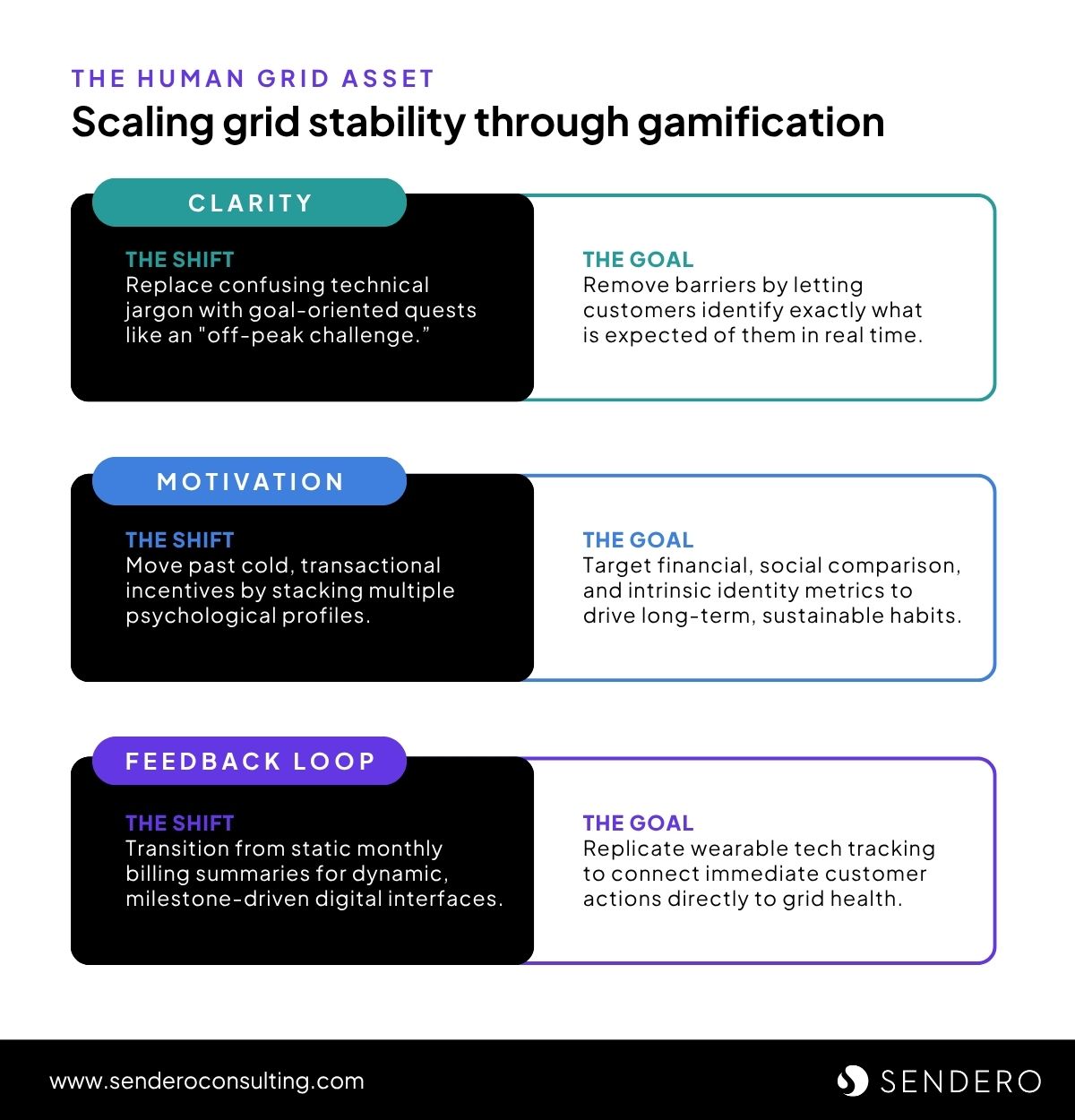
Transforming customer engagement into a reliable grid resource requires a strategic shift from static data to a behavioral framework built on clarity, stacked motivation, and dynamic feedback loops.
The first pillar, clarity, centers around stripping away the often-confusing technical jargon that has historically defined utility communications and instead providing intuitive “quests” that hold tangible meaning for customers. For example, an effective implementation of an “Off-Peak Challenge” simplifies the objective by replacing complex data with a clear, goal-oriented mission that features a defined start and end point. By framing grid-stabilizing actions in such a transparent way, these tasks become significantly more accessible to the average customer, allowing them to identify exactly what is expected of them in real time. This level of clarity ultimately removes one of the primary barriers to participation in most energy programs.
The second pillar, motivation, focuses on implementing varied incentives to trigger different psychological profiles: economic, social and identity. While many programs rely on incentives associated with only one of these profiles, true behavioral scaling requires a multi-layered approach that addresses the diverse psychological facets that meaningfully drive human action. By stacking these incentives, utilities can create a more resilient engagement model. As the initial novelty of one incentive begins to fade, the others are positioned to pick up and maintain momentum.
- Economic incentives, traditionally used by utilities and expected by consumers, provide immediate financial benefits. Much like a local grocery store offering fuel points to turn a routine grocery run into a game to lower gas prices, utilities can use tangible rewards to transform energy usage into an engaging experience. While research suggests that economic incentives can be impactful in the short term for simple, well-defined behavioral goals, they should be paired with other psychological levers to prevent the program from being viewed as merely a transactional exchange. To achieve the macro-grid effect needed today, these rewards must be supported by social and identity-driven incentives to foster long-term, sustainable behavioral change.
- Social incentives rely entirely on community norms and comparative influence to drive action. Humans are inherently social and we have a natural inclination to see how we stack up against our peers, so even invisible energy consumption can become a point of engagement when framed through a social lens. For example, if you have a black belt in martial arts, it signifies your status, changing how people may perceive you and, more importantly, how you behave. By leveraging a similar psychological drive in energy consumption, utilities can unlock a key motivator.
- Identity incentives align with personal values, sustainability and civic contribution. This profile is arguably the most powerful incentive because it taps into intrinsic motivation, which is the internal drive to act in a way that is consistent with how one perceives themselves. For example, a traveler may take an inconvenient route, possibly adding an additional stop on their trip, just to maintain “Platinum Status” with an airline. Additionally, by framing grid-stabilizing actions as a form of civic duty or environmental stewardship, utilities can ensure that positive behaviors are sustained long after the initial novelty of a financial reward or social comparison has faded.
The third and final pillar is feedback, established through real-time loops that mirror the “streaks” and milestones found in successful healthcare wearables. A 2023 study found that 30-35% of Americans regularly utilize a wearable smart device to track health metrics ranging from sleep patterns to calories burned. Achievement features like the Apple Watch “rings” are particularly effective because they motivate users to reach their goals through quantifiable, real-time measurables. The power of these milestones lies in their ability to transform abstract goals into a series of emotionally resonant events. By mirroring this experience, utilities can bridge the “cognitive gap” with a sustained feedback loop, reinforcing positive behavior and connecting a customer’s immediate actions to grid health.
To begin implementing these feedback loops, utility leaders must design digital interfaces that move away from static monthly summaries and toward dynamic, milestone-driven tracking. Operationally, this requires translating raw consumption data into immediate, visual progress indicators, such as localized grid-health “streaks,” community milestones or digital badges, that reward ongoing participation. This feedback pattern can provide the essential emotional impulse necessary to turn a general user into a permanent steward of the grid.
Integrating data for real-time action
To drive real-time gamification, utilities must bridge the gap between back-office IT and Operational Technology (OT) to ensure usage data is reflected in the gamified interface instantly. Without this synchronization, the real-time feedback loops required to mirror the “streaks” and milestones of modern digital experiences are impossible to maintain. Alternatively, when unifying these systems, utilities can foster actionable dialogue with the customer.
For data integrity and scalability, utilities should establish robust data governance and cloud-based platforms capable of handling the influx of feedback data from millions of residential endpoints. A centralized, cloud-based approach ensures the platform remains resilient and capable, even during periods of high-velocity data processing, without compromising security or accuracy. Ultimately, this infrastructure is crucial for maintaining a transparent and trusted relationship between the utility and the engaged customer.
Utilities should also implement Artificial Intelligence (AI) and Machine Learning to process complex datasets, allowing the organization to move from a reactive to a proactive state. By leveraging tools like predictive analytics, utilities can be equipped with the capability to issue “challenges” to customers proactively, well before a grid event occurs. Rather than reacting to a crisis, these AI tools allow the utility to anticipate load requirements and incentivize behavioral shifts in advance, effectively turning the customer base into a flexible asset for grid stability.
Navigating implementation — leadership and cultural alignment
Another major component of successful gamification is the dedicated buy-in from utility executive leadership. Leadership must shift the organizational mindset to view behavioral programs not as “marketing fluff,” but as a core operational necessity. Like with the implementation of any transformative digital strategy, there is significant risk of change fatigue across the workforce if the vision is not clearly articulated from the top down. Without this cultural alignment, a significant barrier is created, preventing this aggregated demand flexibility from evolving into a truly resilient and scalable pillar of grid stability.
To effectively manage change fatigue, utilities should ensure that digital integration and new customer-facing tools are rolled out with a focus on seamless collaboration between technical teams and customer experience units. This unified approach to cross-departmental collaboration breaks down the traditional silos that often hinder the deployment of strategic initiatives. Utility leadership must create and ensure a streamlined implementation process to prevent the rollout of fragmented tools that overwhelm staff and confuse customers.
Furthermore, as the grid becomes increasingly interconnected, the prioritization of cybersecurity within this engaged ecosystem is paramount. In an active consumer digital landscape, utilities must prioritize protecting customer data and intellectual property by implementing rigorous protocols. This includes adopting a zero-trust architecture to verify every access request within the network. For example, a technician accessing grid data from a mobile device should be routinely verified through identity-based permissions to ensure that a single compromised device cannot threaten the broader system.
Utilities should also utilize end-to-end encryption for all data in transit. This eliminates the risk of exposing sensitive usage patterns — such as data indicating whether a customer is or is not at home — which is essential for maintaining the transparent, trusted relationship necessary for a behavioral program to succeed. Another vital security tool is multi-factor authentication, which adds a critical layer of defense alongside automated threat hunting to proactively scan the network for any indicators that the system could be compromised. These security layers allow utilities to manage the risks that come with increased digital connectivity while ensuring that the behavioral layer of the virtual power plant remains a resilient and secure pillar of grid stability.
Looking ahead
While billions of dollars continue to be invested in smart grid hardware, the transition to a cleaner, more resilient grid cannot be achieved through infrastructure alone. While modern infrastructure generates a wealth of actionable data, that intelligence remains stranded if the end-user stays disconnected from the process, leaving the full value of those extensive investments untapped.
As we look toward an increasingly decentralized energy future and mounting pressure on utility companies to balance decarbonization with affordability, the role of the customer will become more critical. When behavior is intentionally designed and treated as a formal grid asset, utilities can transform their consumer base from passive users into flexible, reliable resources for grid stability. Utilities that master the “how” of behavioral integration will see enhanced resilience, higher customer satisfaction and a sustained ability to meet aggressive environmental goals. Ultimately, the most powerful hack for the modern grid isn’t just the implementation of more expensive hardware, but the intentional engagement of human behavior.

Alex Hill joined Sendero Consulting in June 2016 and currently serves as senior manager. In this role, Hill leads project management and system implementation initiatives across the electric utility, healthcare, financial services and oil and gas industries. Notably, Hill recently leveraged her extensive project management expertise to guide the execution of Sendero’s largest-ever IT application implementation. Her industry impact is further highlighted by her recent collaboration with a major Texas utility, during which she helped establish the program management disciplines needed to successfully execute a $3.4 billion System Resiliency Plan. Hill holds a Bachelor of Science in accounting & marketing from the University of Oklahoma.


