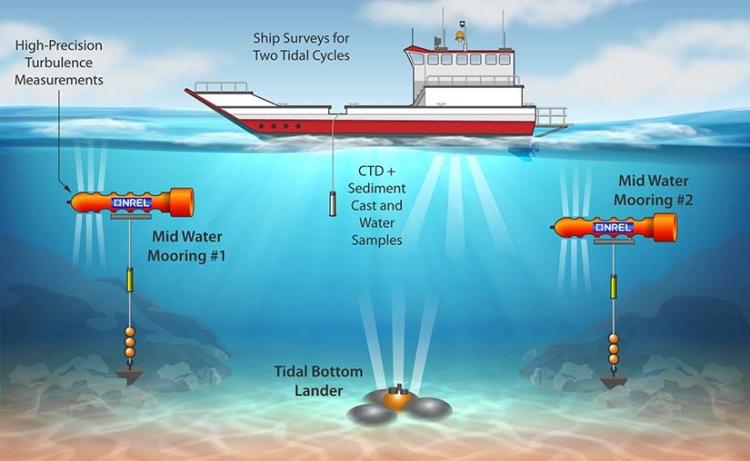
Midwater moorings and the Tidal Bottom Lander were in the water throughout July and August 2021. The ship's surveys conducted in late August measured the cross-channel variability of current speeds, sediment concentrations, salinity, and temperature. Illustration by Al Hicks, NREL
The ocean was calm when the Peregrine Falcon ship left the harbor in Homer, Alaska, last month with three moorings resting on its deck, all loaded with scientific instruments. Eighteen hours later, these moorings were lowered into the silty waves where they collected data for two months.
A highly energetic corner of the Pacific Ocean, Cook Inlet holds one of the greatest tidal resources on Earth. All that energy has the potential to reduce Alaska residents' dependence on declining oil and gas production and provide excess renewable energy that could stimulate the Alaskan economy.
Media may contact:
David Glickson
303-275-4097
david.glickson@nrel.gov
Learn more about NREL's security and privacy policies.
NREL is a national laboratory of the U.S. Department of Energy, Office of Energy Efficiency and Renewable Energy, operated by the Alliance for Sustainable Energy, LLC.
For more information

1617 Cole Blvd
Golden Colorado
United States 80401-3305
www.nrel.gov