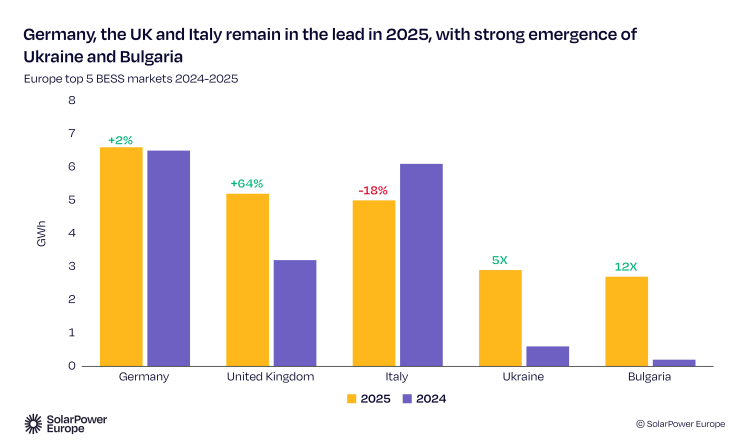
Ukraine has surged to become Europe's fourth-largest battery storage market, installing almost 3 GWh of battery energy storage systems (BESS) in 2025, 5 times more capacity than in 2024, according to SolarPower Europe's European Battery Market Outlook 2026-2030. Only Germany, the United Kingdom and Italy installed more battery capacity than Ukraine.
More than 60% of new capacity came from distributed storage, with households, businesses, schools, hospitals, water treatment facilities, and other critical infrastructure increasingly relying on solar-plus-storage systems to secure, stable, and reliable power supplies. Utility-scale batteries accounted for almost one-third of new capacity, providing much-needed flexibility and balancing services to the power system.
Vladyslav Sokolovskyi, Chairman of the Board of the Solar Energy Association of Ukraine (SEAU) said:
"Ukraine is proving that batteries are more than an energy technology, they are a resilience technology. Our market is also structurally different from the rest of Europe, and that difference sits in the distributed segment. Across Europe, a home battery is typically bought to optimise an electricity bill and store rooftop solar. In Ukraine it is bought to keep the lights on. Apartment dwellers and homeowners are installing small systems averaging just 3 to 5 kWh - around half the European average, and many with no solar attached at all - purely to ride through outages. The overall size of the residential segment is also significantly shaped by the large number of portable power stations (power banks) with a capacity of 0.6 to 2.5 kWh, which households are buying in large numbers specifically for standalone power during blackouts. Small and medium-sized businesses install larger systems for the same reason: energy security first, economics second. Alongside this, utility-scale projects are now competing in the ancillary services market and in energy arbitrage. As Ukraine rebuilds, battery storage will be critical to delivering a secure, flexible, and sustainable energy future."
Sonja Risteska, Head of SolarPower Europe's Battery Storage Europe Platform, added:
"Four years into Russia's invasion, Ukraine has rapidly recognised the strategic importance of solar and battery storage for energy security. As attacks on critical energy infrastructure have exposed the vulnerability of conventional generation, the country has accelerated battery storage deployment at an extraordinary pace, strengthening resilience and maintaining security of supply. Ukraine's experience shows that batteries are more than a clean energy technology; they are an essential asset for energy security and system resilience."
In 2025, Ukraine entered the top five of Europe's largest battery storage markets in 4th place, ahead of Bulgaria and following Europe's three largest battery storage markets: Germany, the UK, and Italy. Ukraine and Bulgaria each added close to 3 GWh of battery storage capacity in 2025. Ukraine's growth was driven by the urgent need for energy security and system resilience, while Bulgaria recorded the highest growth rate in Europe following successful utility-scale funding programmes and is expected to continue its rapid expansion through 2027.
Across Europe, battery storage remained on a record-breaking growth path in 2025, with 36 GWh of new installations marking the twelfth consecutive year of record growth. Total operational battery capacity surpassed 100 GWh for the first time, while annual installations grew 48% year-on-year, driven increasingly by utility-scale projects.
Notes:
- This data is taken from SolarPower Europe's European Battery Market Outlook 2026-2030.