Researchers from the Schulich School of Engineering are advancing the tools needed to support the safe, efficient and reliable use of hydrogen technologies as momentum builds around hydrogen infrastructure development.

XiaoHang Fang, associate professor in the Department of Mechanical & Manufacturing Engineering. Photo Credit: Fritz Tolentino
The multi-year project focuses on advancing flame and detonation arrestor technologies critical components for managing risk and maintaining system performance in hydrogen fuel applications.
It is led by Dr. Xiaohang (Leo) Fang, PhD, assistant professor in the Department of Mechanical and Manufacturing Engineering, and was awarded a $1.27-million grant through Alberta Innovates' Hydrogen Centre of Excellence.
Supported also by Schulich's Momentum Initiative (Energy & Manufacturing Steams) and Convergent Science, the project brings together a team of researchers from UCalgary, the University of Ottawa and the University of Waterloo.
Putting out the fire
Fang's research team focuses on combustion science the study of how fuels burn to improve how hydrogen can be used as a safe, efficient energy source for residential, industrial and aerospace applications.
Hydrogen offers significant promise as a clean energy carrier, but its higher reactivity compared to conventional fuels like natural gas poses unique safety challenges if not carefully managed.
To address these challenges, the team takes a unique approach to its research utilizing algorithms, machine learning and experimentation.
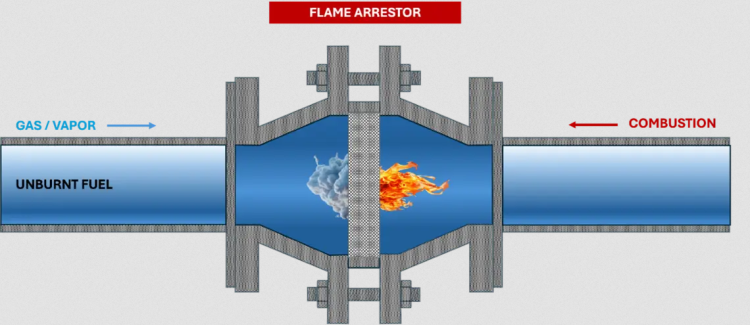
Diagram illustration of a flame arrestor at work. Courtesy of XiaoHang (Leo) Fang
At the core of the project is the development of advanced flame or detonation arrestors safety mechanisms designed to stop flames or explosion waves from spreading through equipment such as pipelines, burners or aircraft engines.
"If an unexpected ignition or blast occurs, these devices act as a safeguard or kill switch, preventing further damage," says Fang.
While laboratory experiments allow researchers to study hydrogen combustion at small scales, Fang says the ultra-precise data generated through experiments allows the team to model combustion behaviour at much larger scales.
Laying the foundation for future hydrogen systems
The project will benefit from a broad collaborative network that includes academic and industry partners across Canada. The research tools will be developed in house and validated through these partnerships, helping ensure the models are accurate, reliable and grounded in real-world conditions.
Working with industry will also allow the team to explore how the tools could be integrated into existing software and systems, supporting faster adoption and practical use.
"What's interesting is that these tools work both ways," says Fang.
"We're not only learning how to stop a flame or detonation we're also gaining insight into how they're generated and how that energy can be used."
While the project's immediate focus will be on the safe use of hydrogen, the same tools and methods could also be applied to power generation and propulsion systems, including future aerospace applications.
As global energy demands grow and traditional resources become increasingly constrained, hydrogen is expected to play an important role in future energy systems, with UCalgary researchers helping advance what comes next.
Learn more about research at the Schulich School of Engineering.